Open post

Are you wishcycling?

“Wishcycling”? It doesn’t work.
Putting something in a recycling bin and hoping for the best doesn’t make it recyclable! I should know, I do it all the time (that’s Keith, not Anne). So when this great email landed the other day from the excellent Green Salon Collective, I decided to share it here. (With some tiny edits.)

WISHCYCLING wish·cy·cling noun
The act of putting something into recycling because you hope it can be recycled……rather than knowing it can.
Take the wish out of recycling
BE HONEST…Have you ever done this?
Finished a colour tube. Looked at the recycling bin. Thought: “Surely they’ll recycle that?” That’s wishcycling.

The salon wishcycling list.
These are exactly the kinds of things that can cause confusion in salons.
Used hair foils.Covered in colour and probably not wanted in your standard recycling.
Colour tubes. Metal? Yes. Automatically recyclable through your normal service? Not necessarily.
Cut hair. Natural doesn’t automatically mean your commercial waste provider has somewhere useful to send it.
Compostable towels & capes. Compostable only helps if they’re actually sent into a suitable composting waste stream.
Coffee pods. Mixed materials and leftover coffee can make these tricky for conventional recycling.
Gloves & PPE. Not something you should assume can simply go into mixed plastics.
Contaminated plastics & packaging. Putting the wrong materials into mixed recycling can contaminate the waste stream rather than helping it.

THE PROBLEM
The recycling bin isn’t a magic portal.
Your local council or commercial services can only recycle the materials their collection and sorting system is designed to handle. Items that aren’t accepted can be rejected, treated as contamination or end up joining the general waste stream. And general waste can ultimately be burned for energy or sent to landfill.

The wishcycling journey
1.Finish the colour service. Foils and colour tubes are left behind.
2.Put them in the recycling. Because they’re made from metal, they feel recyclable.
3.Hope for the best. You assume the waste company will sort it out.
4.It gets sent to landfill which generate lots of nasty ammonia, the most potent green house gas.
Because specialist salon waste needs a specialist route.

GOOD NEWS
You don’t have to wish. You can actually know where your salon waste is going. That’s where specialist recycling comes in.
Green Salon Collective was created specifically for the waste that hair salons generate.
Instead of hoping your salon waste can be recycled, you separate it into the correct waste streams and we give it a proper onward route.

AND BEFORE YOU ASK…
No. You don’t need to wash every foil. With Green Salon Collective, used foils and colour tubes don’t have to be spotless before you send them to us. That means less faff for your team, less uncertainty and no throwing specialist salon waste into a general recycling stream and hoping it doesn’t cause contamination.

THE DIFFERENCE:
WISHCYCLING “I think it’s being recycled.”
GSC “I know it’s being recycled.”

Final editor’s note. Other waste management and recycling contractors are available but they don’t send us cool emails.

Open post

Together we change the world

Together we change the world is the title of my show for Olivia Garden at this year’s Hair Con in Manchester in June. HairCon itself was an amazing experience. This was its third year, and the momentum it’s gained in that time is incredible. Electric, creative, and buzzing are the words that come to mind to describe the weekend. And the cherry on the cake: I caught up with so many hairdresser friends I only ever seem to see at hair events. I had an absolutely fantastic time.

I was thrilled to be able to present on the Main Stage, courtesy of my favourite hair tools manufacturer Olivia Garden. With an audience of several hundred hairdressers, I wanted to share the sustainability message using the medium all stylists love: fabulous hair!

Inspiration Behind the Show

The whole idea for the show came out of a meeting with a group I belong to, the Sustainable Hair Alliance (formerly Fellowship Net Zero). We come together to promote sustainability within the hair industry, communicating our message through webinars, talks in colleges and social media.Check out the SHA community here.

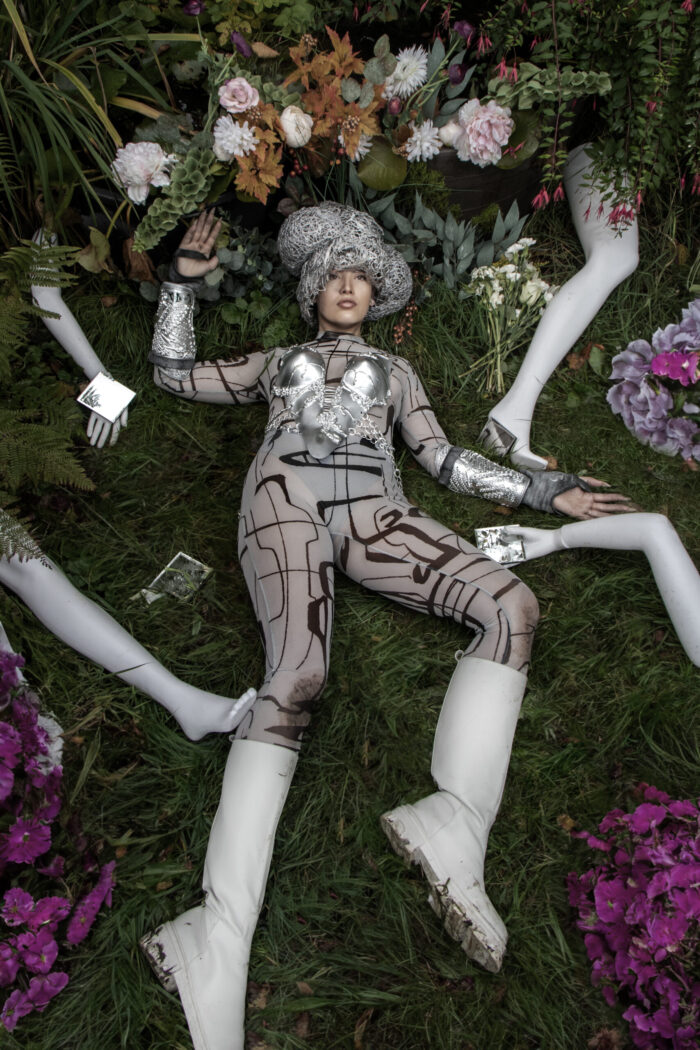
My idea was to take a more creative approach after all, hairdressing is a visual craft, and we love anything creative. I wanted to tell a positive story about nature. The narrative begins in a desolate world, where robotic figures wander around, helpless. But gradually, they transform into creatures of nature because nature can recover, given the chance.

Each look represents a season.

The Last Winter

Before the sap even begins to rise again, the forest still speaks in dead signals, bare branches like rusted antennae, searching for a frequency nature hasn’t forgotten. Beneath the metallic frost of its old skin, green moss is already creeping in, the first proof that even a frozen body can become root again.

Green Return

Where winter left bare branches, spring answers with colour, leaves unfurling, fruit swelling on the vine, life pushing upward without asking permission. This is nature mid-sentence: not yet finished growing, still wild, still reaching in every direction at once.

Full Bloom

This is the moment nature stops holding anything back: every flower open at once, every branch heavy with blossom, nothing left in reserve. Where spring was still reaching, summer has arrived: soft, full, unguarded, spilling outward with nothing left to give but more.

You can watch the show on my youtube channel .(Don’t forget to subscribe!)

I hope this is what you were after,

Speak soon,

Open post

Latest good news from Kirinya Children’s Centre in Uganda

As you know (we hope!), Anne is fundraising to develop a hairdressing training programme for young women in rural Uganda. At the same time, the local community together with international charities have recently had great success with the bigger development project in which Anne’s hairdressing initiative sits. So we thought we’d share this with you to encourage you to stay involved. Anne has set a target of £5,000s and has reached £3,200 already. Huge thanks to everyone but we need more!

Here’s the latest news contained in this slightly edited email trail….

Funding for Water Projects at Kirinya Children’s Centre, Uganda

Great news re funding from two sources.

Everything is going well at Kirinya Children’s Centre Nursery and Primary School. We have had funding to replace the school bus which was very old and unreliable amongst many other wonderful achievements. One of the major projects was having to build a wall to separate us from the water supply on the government land. There was a need for even greater security than we already have. Thank you so much for providing our own supply of water which was very timely.

It is very unusual for us to be able to respond immediately to a funding request. However I am pleased to tell you that, due to chance convenient timing, the WWfA Trustees have agreed to fund your most urgent request:- New toilets for the Nursery at £3013. Our Treasurer will contact you shortly to arrange the transfer of this sum.

Coming back to Andrew (a private donor)…he agreed £3,600 for toilets plus rest room. He’s sent it via CAF (Charities Aid Foundation) but it’s not arrived yet. We’ve been checking daily so yesterday when it still hadn’t come through he decided to send £2,000 directly to HMOF charity account to get the work started as he wants us to be able to get the work done before Term 3 starts on 15th September. Andrew’s money will build the rest room and also furnish it with mattresses and carpet the three classrooms which they want.

Tables for the dining hall and beds were high priority so I’ll see how we get on. We recently had funds from three Lymm Brownies who did a lemonade sale which bought 2 triple deck beds. Every donation is precious.

In addition we also have a hair salon at school built on the end of the Primary school with fundraising by Anne Veck the hairdresser who came. It’ll also be used for massage and manicure and significantly adds to our training program. She’s still fundraising and returning in November. Watch this space!

I’m delighted. I really needed some good news this week and I’m sure you all do too. We’re all doing what we can under whatever circumstances!
Love with thanks from Helen 🙏

Helen Margaret Owen is the founder of the foundation which began this project back in 2009.

Open post

Plastic Free July

It’s Plastic Free July! Well we all know there is simply too much plastic on the planet, from the gyres in the oceans, to the plastic rubbish in the countryside, to the micro plastics and forever plastics in all living organisms and ecosystems, and that includes you!

Because it is so hot at the moment (and of course the underlying causes of plastic pollution and climate change are the same:growth and fossil fuels), we are feeling too lazy to write an original blog today. We have blogged about plastic before and new regulations are coming in in the UK for small busineses like hair salons in 2027. (More here)

Therefore what follows is taken from a great email that arrived in our in tray yesterday from one of our favourite brands Shedid and Parrish, with some great suggestions about what you can do to make a difference (and buy their wonderful nproducts too of cpurse). Here goes…

“It’s plastic free July, a now global movement. It started in 2011 in Western Australia, by a woman (of course!) Rebecca Prince-Ruiz and her team. What started as a small idea has now taken off and followed by many!

We’d be hard pushed (certainly in Europe these past few months) to not realise that we really do need to look after our planet.

It’s not about one mammoth change, I’ll be the first to admit that whenever I choose something too grandiose, I lose the momentum way too quickly. It’s about small changes that contribute to a bigger whole.

I’m proud to say that at Shedid & Parrish, we’ve thought about our part from the get go. Whether it’s the ingredients we choose (to ensure we’re not depleting resources that can’t be replenished) the 3rd party businesses we work with (with full traceability so we know we’re directly supporting the growers and farmers) or how we extract the oils and nutrients (choosing sustainable methods) that not only retain the nutrients better but are less harmful and use less power. And of course the most obvious – being plastic free and choosing recycled aluminium so we’re not further contributing to the plastic mountains.

Chosing Recycled Aluminium
How we source our Shea

And the truth is, we can all do our bit. So if you’re wondering what small changes you can make, here’s a few of my favourites;

Upcycle food – I often make more than can be eaten in one sitting, and the truth is many of us don’t want to eat the same thing day after day. So… turning unfinished meals into great new meals is a winner. Unfinished veg are great in new pasta dishes, or turning mash potato into a pie topping. There are so many ways to be creative – as long as the food isn’t thrown out, its a win!

Drinks on the Go – carrying a water container, whether you think you need it or not. The truth is, it’s always when I don’t think I’ll need a drink that I’m pleased it’s there!

Storing veg – those little fabric bags (also sold as a washing protective bra bag) are great. They not only keep the veg fresher for longer (less waste) but mean you can source without the plastic packaging. I absolutely love them!

Water – my favourite (as I drink so much fizzy water) is the soda stream (other brands are available I’m sure) I used to buy loads of water bottles and create a mountain of plastic waste as a result. For years now, I’ve been a firm fan of the soda stream. I replenish my bottles as needed, don’t have the same storage issues, don’t create plastic waste and never run out!

Refills – We have to finish with the obvious! Given our bottles are recycled aluminium, they can be used time and time again. Perfect for your getaways – just bring back the finished bottle (rather than leaving at your destination) and refill it on the return, ready for the next trip! We’re working on larger format refills too but it’ll take time. If you can get your full size bottles back to us in London, we can refill them aswell, if you’re interested, get in touch!”

And as a thank you to the lovely Jessica for borrowing her blog, find out more about Shedid & Parrish here!

Open post

Hairdressers could be a secret weapon in tackling climate change

Hairdressers could be a secret weapon in tackling climate change, new research reveals! This is really interesting and builds on previous research by Prof. Denise Baden at Southampton University Business School. The study was revealed in Humanities & Social Sciences Communications.

Hairdressers across the UK are emerging as powerful, under-recognised influencers in tackling climate change, according to new research from academics at the University of Bath’s Centre for Climate Change and Social Transformations (CAST), and the Universities of Cardiff, Oxford and Southampton.

The study reveals that hair salons are hubs of trust, community and conversation where climate action can take root and spread.

The research shows that hairdressers can be influential in everyday conversations with clients about climate and sustainability and are successfully prompting people to rethink their sustainability habits – ranging from their use of water and energy to their choice of bank or diet.

Dr Sam Hampton from CAST said: “Hairdressers build trust over months and years. That kind of relationship is gold when it comes to discussing climate change. We found salons to be unique spaces where clients feel safe, relaxed, and open to new ideas.”

The research team conducted in-depth interviews with 30 salon owners and directors about their climate and sustainability interactions with clients and ran a nationwide intervention in 25 sustainable salons using ‘Mirror Talkers’ – eco-tips placed on salon mirrors to prompt sustainable haircare conversations.

Denise Baden, Professor of Sustainable Business at the University of Southampton said: “Most of us think a ‘green’ product is one with recyclable packaging, but the carbon footprint of shampoo is mostly in the hot water used, so simple messages such as ‘most of us use too much shampoo and shampoo too often’ can prompt conversations about how shampooing less and at lower temperatures saves time, money, energy, water and is better for your skin and hair condition.”

Key Findings
Trust creates impact: Hairdressers build long-term, often decades-long relationships with clients. Many are seen as confidantes or even counsellors. This trust creates a space where advice is both welcomed and acted upon.
Conversations are already happening: Nearly all participating salons reported chats with clients about environmental topics – often starting with haircare, but expanding to plastic use, food choices, energy use and transport, diet, and more.
Measurable Impact: Almost 73% of salon clients said they were likely to change their haircare routine after conversations prompted by the Mirror Talkers. Some reported switching to eco-friendly products, turning down their hot water, or changing habits at home.
Coining the term ’everyday influencers’, the researchers argue that public-facing professionals like hairdressers should be seen as frontline agents of climate engagement.

Dr Briony Latter, a CAST member based at Cardiff University, said: “We’re used to thinking of people in the public eye, such as celebrities, as influencers. But what about the people you actually talk to on a regular basis who know you and who you trust with your appearance and sometimes more personal aspects of your life? Hairdressers have an untapped ability to weave climate change into everyday conversations and actions.”

With over 61,000 hair and beauty businesses in the UK contributing £5.1 billion to the economy, the research offers a blueprint for policymakers. It recommends:

Integrating sustainability training into hairdressing education and apprenticeships
Rolling out conversational tools like Mirror Talkers nationally
Recognising salons as valuable spaces for public climate engagement, particularly among women and local communities
Dr Sam Hampton said: “If we’re serious about building a public movement for climate action, then it’s time to invest in these unsung influencers because real change starts in everyday conversations, not just in Westminster.”

Great stuff and something we have been campaigning about for years! Latest action YOU can take is to join the hairdressing NET ZERO platform for more information, to discuss hairdresing sustainabilty with other hairdressers and to support our campaign to get sustainabilty included in the hairdressing college courses and apprenticeships. And for more on sustainability in hairdressing and links to our Salon and Freelance RE:Source tool kits go here now!

Open post

Is hairdressing an industry in crisis?

Anne thinks aloud about the challenges facing hairdressing in 2026. Is the industry in crisis?

Hairdressing’s present and future is based on professionals sharing and supporting each other. I try to consciously give to support other people in the industry? Time, knowledge, introductions, training, honest advice, flexible opportunities, credit, encouragement.

My commitment to the next generation of professionals is built on one core principle: Education is freedom. I believe in “lifting as I climb.”

I have visited Uganda to share what I know with young women in a rural orphanage. It’s about giving them real hairdressing skills in collaboration with local professionals so they can stand on their own two feet and find financial independence. Whilst doing this, I learn textured hair skills directly from the experts.

At home, I use my platform to open doors. Whether it’s working with the Fellowship Net Zero group or mentoring, I want to make sure the next generation of stylists has a seat at the table, and the business confidence to stay there.

So, it’s not just about what I can give. I get so much back in return personally and professionally.
A stronger team, business growth, loyalty, confidence, collaboration, perspective and sometimes something unexpected!

A real perspective: My work in Uganda and with young stylists keeps me grounded. It reminds me why I started and keeps my own passion alive.

A team I can trust. When you truly invest in people, they stay with you. I’ve gained incredible loyalty and a team that isn’t afraid to innovate with me.

Confidence to keep going. Honestly, seeing a student “get it” or watching a mentee fly is the best feeling. It validates everything I’ve done over the last 30 years and makes me want to keep learning myself.

However, our industry needs so much more right now! Visibility, financial education, mentorship, fair pay, recognition, leadership opportunities, investment, structured support from government and simply an open conversation about the challenges it faces.

The training and recruitment crisis. New entrants are either declining in number (apprenticeships) or reaching the job market under skilled and under qualified (college students and self-trained non professionals). We need all hairdressers to be competent with all hair types. Currently, the majority don’t know how to work with Type C hair. Anne offers an Introduction to Textured Hair/Afro for Beginners course to help address this.

mandatory registration as they are in most other countries. In the U.K. anyone can operate as a hairdresser, putting the public at risk as well as damaging the reputation of the industry.

The future is concerning. Freelancing is great and the best choice for many. But it is the employment model that recruits and trains new entrants most effectively. The number of apprentices is falling. Many new stylists are only competent is their chosen speciality e.g. bayalage. Will AI and robots fill the gap? Fast forward 30 years and perhaps hairdressers will either be all over 50 or humanoids!

Open post

Braiding- where heritage meets high fashion!


Anne Veck, Salon Business Awards Educator & Texture Expert of the Year, explains…

1. The ‘Clean Girl’ French Braid

Best For: Straight to wavy hair (Types 1-2).

The Style: A sleek, classic braid down the center.

How-to: Start on day-old hair for better grip. Use a tail comb for a straight part.

Essentials: Apply a smoothing balm from roots to ends to stop fly aways. Finish with hairspray.

2. The Halo Twisted Braid

Best For: Medium to thick hair with some length.

The Style: A romantic braid that wraps around the head like a crown.

How-to: Prep the hair with curls before creating two-strand twists from behind the ears. Wrap the twists around the head like a halo, allowing the ends to remain free for a soft, effortless look

Essentials: Use texturizing powder at the roots so the braid doesn’t slip. Secure with kirby grips.

3. The ‘Boho’ Fishtail

Best For: All hair types; looks great with highlights.

The Style: An intricate two-strand braid that looks better as it gets messy.

How-to: Split hair into two. Take a tiny piece from the outside of the left and move it to the inside of the right. Repeat.

Essentials: Use dry shampoo for a “rough” texture. Gently pull the edges of the braid apart for volume.

4. The Fulani-Inspired Accent

Best For: Naturally curly and coily hair (Types 3-4).

The Style: Thin, delicate braids near the face or along the part line.

How-to: Section a small 1-inch area. Braid tightly close to the scalp.

Essentials: A firm-hold edge control or braiding gel is a must to keep the pattern crisp.

For more uber cool inspo ,check out Anne’s gallery Hair is Art.

Open post

Empowering the next generation of hairdressers in Uganda

Thanks so much to Estetica for this wonderful piece about Anne’s new project empowering the next generation of hairdressers in Uganda!

“Impassioned texture expert Anne Veck has launched a vital mission to up skill young women in rural Uganda through the gift of hairdressing.

Anne Veck, the award-winning hair artist and renowned texture educationalist, has recently returned from a transformative journey to the village of Namataba, Uganda. Known for her mastery of afro and textured hair, Anne swapped the high-end salons of the UK for a volunteer mission to empower and upskill five enthusiastic young women. The trip was more than just a training session; it was a deeply personal exchange of knowledge and heart. Anne sensed an incredible hunger for learning displayed by her students, describing the experience as a privilege that set her soul on fire. Having arrived in the UK years ago without speaking English, Anne credits hairdressing as the universal skill that allowed her to build a future. Now, she is passionate about sharing that same gift of self-sufficiency to the next generation in Namataba, turning a spark of craft into a sustainable career path.

(For your own hairdressing and upskilling with Anne get in touch!)

A Legacy of Learning at the Kirinya Children’s Centre.
The backdrop for Anne’s mission is a remarkable school built by Helen Margaret Owen, an inspirational British woman who used her life savings to transform a makeshift shelter into a permanent sanctuary of learning. The Helen Margaret Owen Foundation has become a hub for the community, providing education to hundreds of vulnerable children and orphans. Last year, the foundation launched vocational workshops, revealing an extraordinary well of untapped talent among the village’s young women. Anne’s arrival, supported by professional equipment from BaByliss Pro and Olivia Garden, marked the beginning of a formal hairdressing journey for these students. By integrating vocational training into the school’s curriculum, both Anne and the foundation are laying the groundwork for long-term economic independence in a region that once lacked such infrastructure.

The Goal: Raising £5,000 for Year-Round Mentorship
While Anne’s initial visit was transformative, she recognised that consistent mentorship is the key to lasting success. To ensure this isn’t just a one-off event, Anne has also committed to raising £5,000. This modest but impactful amount will fund a locally sourced professional educator to teach at the school every week for an entire year. This strategy not only supports the young women but also invests back into the local Ugandan economy by employing a skilled professional. By establishing a permanent vocational programme, the project aims to create a guaranteed career path for these women, mirroring the independence that hairdressing provided Anne at the start of her own journey. Furthermore, every pound raised will go directly toward providing the consistent guidance these students deserve to master their craft.

Mastering the Art of Giving Back
Anne is a firm believer that true mastery in hairdressing is defined by what you give back to the industry and the wider world. Her time in Uganda was an exercise in “authentic education,” where she spent as much time soaking up local wisdom as she did teaching. This reciprocal exchange has left her more invested than ever in the growth of the Namataba community. “I never tire of the joy of witnessing the potential for a spark of craft to turn into a career,” Anne commented. Her mission serves as a poignant reminder that hairdressing is a universal language – one that can bridge cultural divides and provide a lifeline to those in need. By supporting this cause, the UK hairdressing community has the opportunity to help Anne turn her passion into a permanent legacy for the stylists of tomorrow.”

Thanks again Gary Kelly at Estetica for this lovely feature.

To help Anne reach her goal and support the stylists in Namataba, please visit her fundraising page

Screenshot
.
Screenshot

Open post

Fellowship Net Zero sustainable hairdressing project launches!

The Fellowship for British Hairdressing launched its “Net Zero” sustainable hairdressing project on Monday 23rd March with a truly engaging and educational webinar.

Featuring hair industry sustainability champions Karine Jackson and Anne Veck with expert moderating by fellow green queen Ashleigh Hodges (also, of course, President of the Fellowship), the session focused on setting the sustainability scene for hairdressers and salon owners.

With nearly 40 participants, the webinar was the first in an ongoing series which aims to equip hairdressing professionals to make a real difference by reducing waste, energy and water use, CO2 emissions and plastic and chemical pollution.

The next webinar on 25th March will feature Zoe Rees of Bliss salons, who together with Lynette at Studio A114, will explore why operating your business sustainably is the best way to be profitable.

Whilst behind the scenes, the team are working with colleges and qualifications bodies to make significant changes in the way that sustainability is included in hairdressing qualifications. Major news about this expected later in 2026!

So please do join the hairdressing Net Zero community! Open to all and the more the better.

And for lots more on sustainable hairdressing get your Anne Veck sustainabilty tool kits –
Salon RE:Source and Freelance RE:Source.

Open post

Hair Equity – why is it missing in qualifications?

Last November the British Beauty Council sent an open letter about hair equity to Baroness Smith, Minister for Skills, calling for mandatory, inclusive hair education within government-funded qualifications. The letter was signed by hundreds (yes really) of hairdressers and industry figures, including Anne.

You can read the letter in full here. It is hard hitting and to the point.

Basically its asks why college qualifications don’t include the National Occupational Standards covering competence in all hair types which were updated in 2020.

And here is the meat of the Minister’s reply.

“Thank you for your correspondence of 25 November, regarding updating
government-funded hairdressing qualifications to mandate training on all hair types,
including textured and Afro hair. I would be grateful if you could share my response
with your co-signatories.
I have noted the points made and very much appreciate the considered approach to
this issue. On the call to unlock funding to implement updated National Occupational
Standards (NOS) across all qualifications, while the NOS provide greater detail than
the English standards, the existing occupational standards in England already allow
for the implementation of that detail through their requirements.
Regarding the call to commit to a fast-track review for inclusive standards, the level 2
hair professional occupational standard was updated in 2023 and made more
inclusive of all hair types and clientele. The updated standard has been praised and
positively received by the sector. As you may know, revision of the level 3 hair
related occupational standard was paused earlier in 2025 due to the transition of the
Institute for Apprenticeships and Technical Education into Skills England.
Thank you also for your kind invitation to meet. Unfortunately, diary pressures mean
that I am unable to accept at this time. However, department officials would be
happy to meet with you to discuss this further.”

Unfortunately, Baroness Smith’s response: “the level 2 hair professional occupational standard was updated in 2023” etc, etc., refers to the qualification embedded in the Hair Professional Standard, that is, the apprenticeship. Similar for comment on Level 3 , the Advanced Professional Standard. She effectively avoids dealing with the issue with regard to Level 2 & 3 diplomas for college students. (As I guess most readers will know, the hairdressing apprenticeship in England includes a level 2 diploma).

The simple explanation is that the hairdressing level 2 diplomas as offered by qualifications bodies including VTCT, qualifi and City and Guilds, were released back in 2015 and haven’t been updated since. (The diplomas included in the Standard aka apprenticeship were published in 2017 and appear to be based on the 2015 versions). So the obvious question is, when exactly will the qualifications organisations get round to bringing their diplomas into the 21st century? (And of course its not only about textured and Afro hair, some colleges are still training students to do cap highlights!).

Frankly, this situation is inexcusable and its good to know that the British Beauty Council are following up. On the immediate practical side, it is of course not the fault historically of so many qualified hairdressers that they weren’t trained in textured hairdressing skills either at college or during their apprenticeship back in the day. However there is no longer really any excuse for experienced hairdressers who lack this skill set, to carry on and accept the appalling situation they find themselves in, never mind their potential clients. CPD training in Afro,textured and curly,coily hair is now widely available.

Including by Anne who offers an “Introduction to textured hair” aka “Afro for Beginners” course. Do contact her about this on 07525498903 and email her at anne@anneveckhair.com. More about Anne Veck Education here.

Posts navigation

1 2
Scroll to top